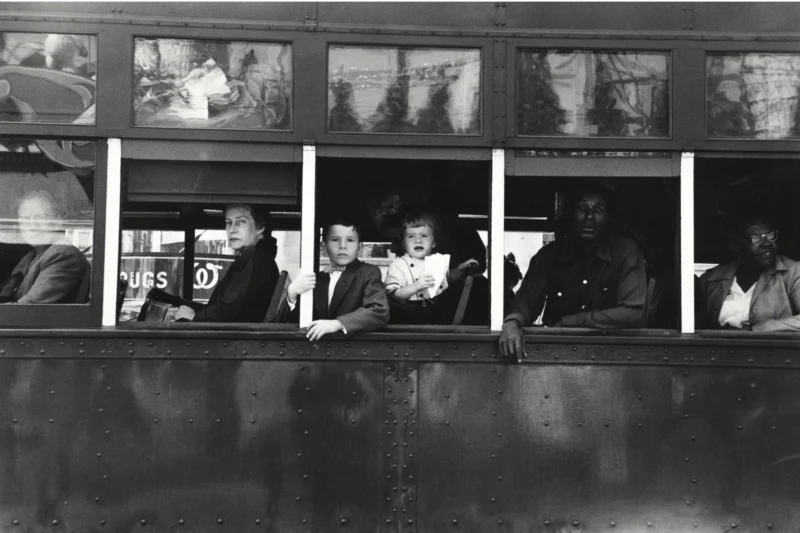
On the occasion of Robert Frank & The Americansthe exhibition hosted on the 4th floor of Espacio Fundación Telefónica and organized alongside the Maison Européenne de la Photographie in Paris, we delve—guided precisely by its curator, David Campany—into the keys of a project that challenged established canons.
History features certain projects and works that act as dividing lines. With The Americans, there is a before and everything that came after. The Americans is the profound photographic portrait with which the Swiss-born Robert Frank revolutionized the 20th century.
For many, the impact of this work remains immeasurable. David Campany categorically states that “For many, Frank´s The Americans is one of the pinnacles of the twentieth century photography; an expression so original, profound and complete, especially in its book form, that it is almost too easy to take its achievement for granted.”
However, when the work first saw the light of day, society’s reaction was a far cry from today´s veneration. The curator recalls that “When it was first published in 1958/59, The Americans was deeply divisive.”
The project represented a radical break from the technical and visual conventions of the era. In Campany´s words, the work “broke with the ideals of what ‘good photography’ was supposed to look like. Off-kilter framing, blur, grain, informality.” But the most significant rupture was not formal, but conceptual and ethical: “More importantly, it broke with the idea that great art should be separate from politics and social commentary.”
This collision with North American reality stemmed from the photographer’s own cultural shock upon crossing the Atlantic. Campany explains that “Arriving from Switzerland with high hopes about the ‘American dream’, Frank was soon disappointed by the USA´s obsessions of money, celebrity, and consumerism, and he was shocked at the depth of the racism”
The recodification of symbols and the value of the outsider
Throughout the extensive road trip that structured the project, Frank identified and captured motifs that repeated constantly. Campany analyzes this iconography, noting that “By the end of the 1960s, the small world of photography had come to recognise the importance of Frank’s project.” Regarding its historical weight, and adds about his visual language: “A along the project, certain motifs se repeat. The flag of ‘stars and stripes’. People somehow alone in the crowd. Cars. Screens.”
The great merit of Frank consisted in transforming the meaning of these everyday elements. “These were already visual items in the American culture, but Frank had recoded them so they felt tense and worrying rather than heroic or celebratory,” Campany adds, clarifying that the photographer “did it with poetry as much as polemic.”
Carrying out an enterprise of this caliber had no close precedents in the country’s history. The historian contextualizes the challenge: “Not since Frank’s mentor Walker Evans published American Photographs in 1938 had a photographer attempted anything like a ‘national project’ in the USA.” It was a gamble at the limit: “It was risky, nearly impossible and bound to bring criticism.” Nonetheless, the final result demonstrated an unwavering stance. According to Campany, “There is an extraordinary bravery to The Americans, a willingness to face unpalatable truths while finding a way to have hope for the nation, and empathy with people.”
This unique perspective was directly linked to his status as an immigrant and outside observer. Campany reflects on this detachment: “Today, photographers, filmmakers and writers are so often encouraged to start with what they know. Their own background, their own experience.” Facing this contemporary trend, he defends that “But great work can come from being outside of one’s comfort zone.”
Robert Frank himself left a written record of the nature of his approach in 1957, just before the book’s publication, embracing the subjectivity of his work: “With these photographs, he have attempted to show a cross-section of the American population. My effort was to express it simply and without confusion. The view is personal and, therefore, various facets of American life and society have been ignored. […] I have been frequently accused of deliberately twisting subject matter to my point of view. Opinion often consists of a kind of criticism. But criticism can come out of love. It is important to see what is invisible to others. Perhaps the look of hope or the look of sadness. Also, it is always the instantaneous reaction to oneself that produces a photograph.”
The human cost of the project and the turn toward cinema
One of the most intimate revelations regarding the production of the work is the tremendous psychological toll it took on Frank. Campany reveals the intensity of the process: “Frank worked with an intense dedication, staying alert and reactive to the world around him over a long period.” Sustaining this level of creative absorption had direct consequences: “This takes a toll on the human nervous system. When it was over, Frank knew it had changed him, and that he would not be able to work in that manner again.” His grand testimony about the country was already definitively recorded.
The curator recounts the change of direction the photographer’s life took: “His statement on the nation had been made, for better or worse,” which triggered a radical reorientation of his camera. “Instead of looking outward on the road, he looked inward, to home and family.” This change marked the close of an era: “He continued to photograph, but with less intensity and turned his attention to filmmaking.”
A historical mirror that continues to challenge the present
What is it about a set of photographs taken seven decades ago that allows them to retain their power to affect today’s viewer? David Campany poses the question bluntly: “What is it about a photograph taken 70 years ago that can still affect you as much as one taken today?”
His analysis places the work within an ambivalent temporal terrain: “No doubt The Americans is absolutely of its time in North American history, in art history, and in Robert Frank’s own creative history.” Even so, the work escapes being read merely as a historical archive: “Even so, it continues to resonate profoundly with new audiences and old. And since there is no time travel, there must be something beyond all the period detail that still feels contemporary, that speaks to us now, in our moment.”
That “something,” Campany clarifies, responds first and foremost to artistic criteria: “That ‘something’ is partly to do with The Americans being art of the very highest standard. Such work is never confined to its original moment.” But on the other hand, it is due to a much more poignant and uncomfortable social reality: “It is also to do with the bitter feeling that the USA really has not made the progress it could have, should have.” Campany actually adds an alarming nuance regarding the current context: “It might even be slipping backwards.” For all these reasons, the curator concludes that, despite the passing of the years, “Decades on, looking at these photographs can still feel like an instantaneous reaction to ourselves.”
History has ultimately proven the photographer’s gaze right, drastically altering the perception of his work. Campany details this chronological evolution: “By the end of the 1960s, the small world of photography had come to recognise the importance of Frank’s project. This led a lot of photographers to try to work in his manner, while for others The Americans could not be repeated or imitated.”
In any case, it paved the way: “Either way, Frank had indicated that the extended ‘road trip’ could be a fruitful way to come to know and picture the country.” With the arrival of the new millennium, historical revision completed the turn: “By the 2000s, the USA had begun to see the 1950s less in terms of happy consumerism and more as an era of anxiety, paranoia and deep-seated inequity.” It was at that very moment that the work acquired its definitive status: “Frank’s The Americans began to shift in the popular imagination from a counter-cultural statement to something more like an official record of a troubled and divided country.”
The exhibition at Espacio Fundación Telefónica offers an exceptional opportunity to encounter this masterpiece. In Campany’s words: “Seeing the full set of images on the wall, in an exhibition space rather than the printed page, allows us to encounter the work afresh.”
The value of the gallery room compared to paper becomes evident: “Every single image is extraordinary in its own right, and yet part of a much greater whole.” The exhibition, which brings together more than 120 iconic works, allows the public to view the complete set of 83 photographs from the original book—on loan from the Maison Européenne de la Photographie in Paris—distributed throughout the room while strictly respecting the exact sequence chosen by Frank.
Furthermore, the itinerary is complemented by additional works by the author from the International Center of Photography in New York and private collections, as well as route maps and enlarged contact sheets that reveal the precision of his visual decisions and the intimacy of his creative process.